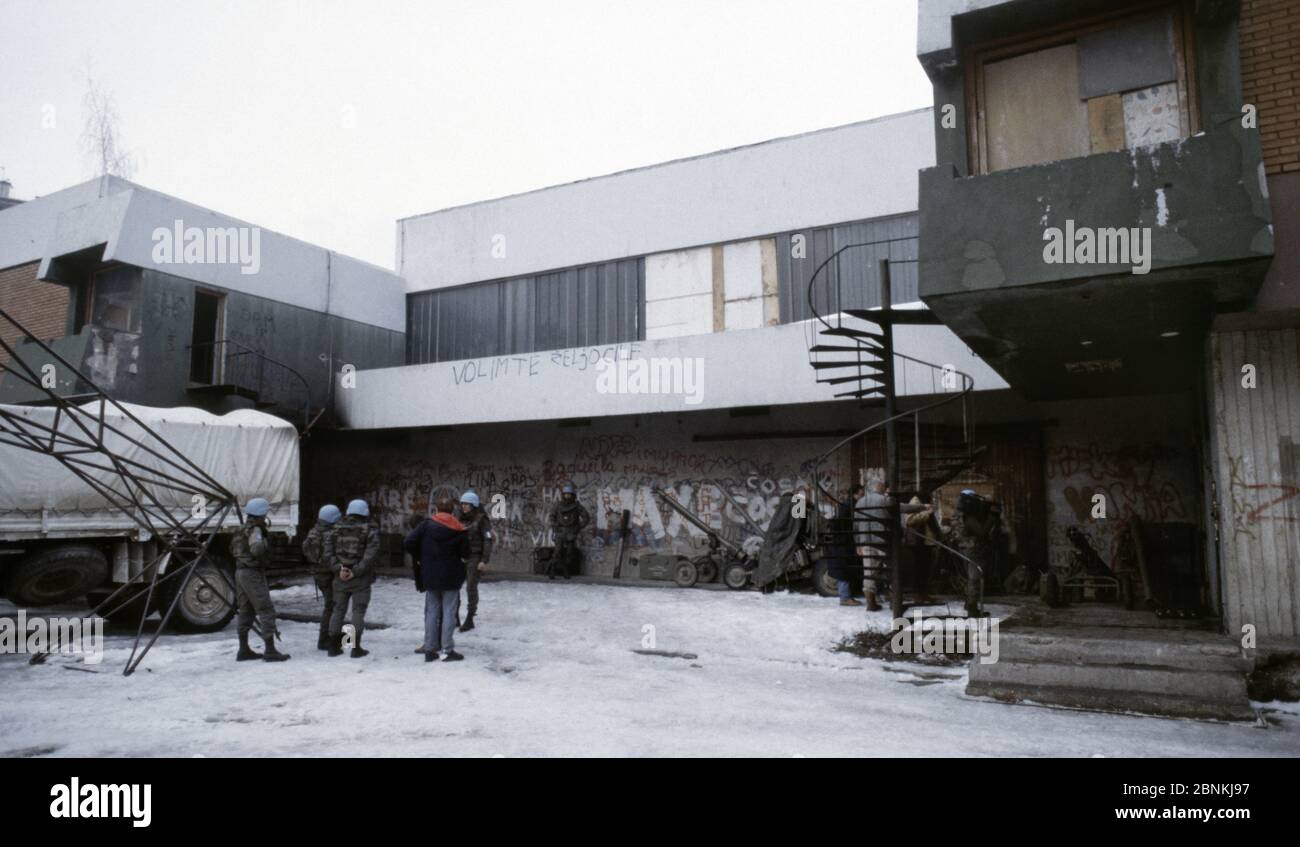
23 febbraio 1994 durante l'assedio di Sarajevo: Soldati francesi custodisce armi serbe bosniache in un cantiere scolastico nella zona di Grbavica della città.
9950 x 5798 px | 84,2 x 49,1 cm | 33,2 x 19,3 inches | 300dpi
Data acquisizione:
23 febbraio 1994
Ubicazione:
Grbavica, Sarajevo, Bosnia & Herzegovina.
Altre informazioni:
Questa immagine potrebbe avere delle imperfezioni perché è storica o di reportage.
On the 9th February, the North Atlantic Council issued a statement calling "for the withdrawal, or regrouping and placing under UNPROFOR control of heavy weapons of the Bosnian Serb forces located in the area within 20km of the centre of Sarajevo, and excluding the area within 2km of the centre of Pale". It also called upon the Muslim-led Government of Bosnia and Herzegovina, within the same period, "to place the heavy weapons in its possession within the Sarajevo exclusion zone described above under UNPROFOR control and to refrain from attacks launched from within the current confrontation lines in the city." The NAC decided that, ten days from 2400 GMT 10 February 1994, heavy weapons of any of the parties found within the Sarajevo exclusion zone, unless controlled by UNPROFOR, would, along with their direct and essential military support facilities, be subject to NATO air strikes. The difficulties and confusion of the operation were clearly evident at the schoolyard in the mainly Serbian district of Sarajevo called Grbavica, one site for the collection and control of Serbian weapons. A group of about 10 French soldiers stood guard over a rather paltry collection of weapons that they said had been handed over in the past 24 hours: two 76-millimetre guns, four 82-mm M60 recoilless guns and one 90-millimetre gun. “Look, we have been here since last week to help a humanitarian operation, not to gather military intelligence, ” said Col. Jean-Paul Monfort, who was overseeing the operation. Although independent analysts say they believe that the Serbs had 350 to 500 artillery pieces around Sarajevo, Colonel Monfort said: “We do not know exactly how many heavy arms the Serbs have. Some of the weapons are frozen into the ground, and we can't budge them for now. Most of the weaponry is being removed beyond 20km rather than being handed over. All I can say is that this is all we have received so far.” ITN reporter, Michael Nicholson, stands pointing at a gun on the right.