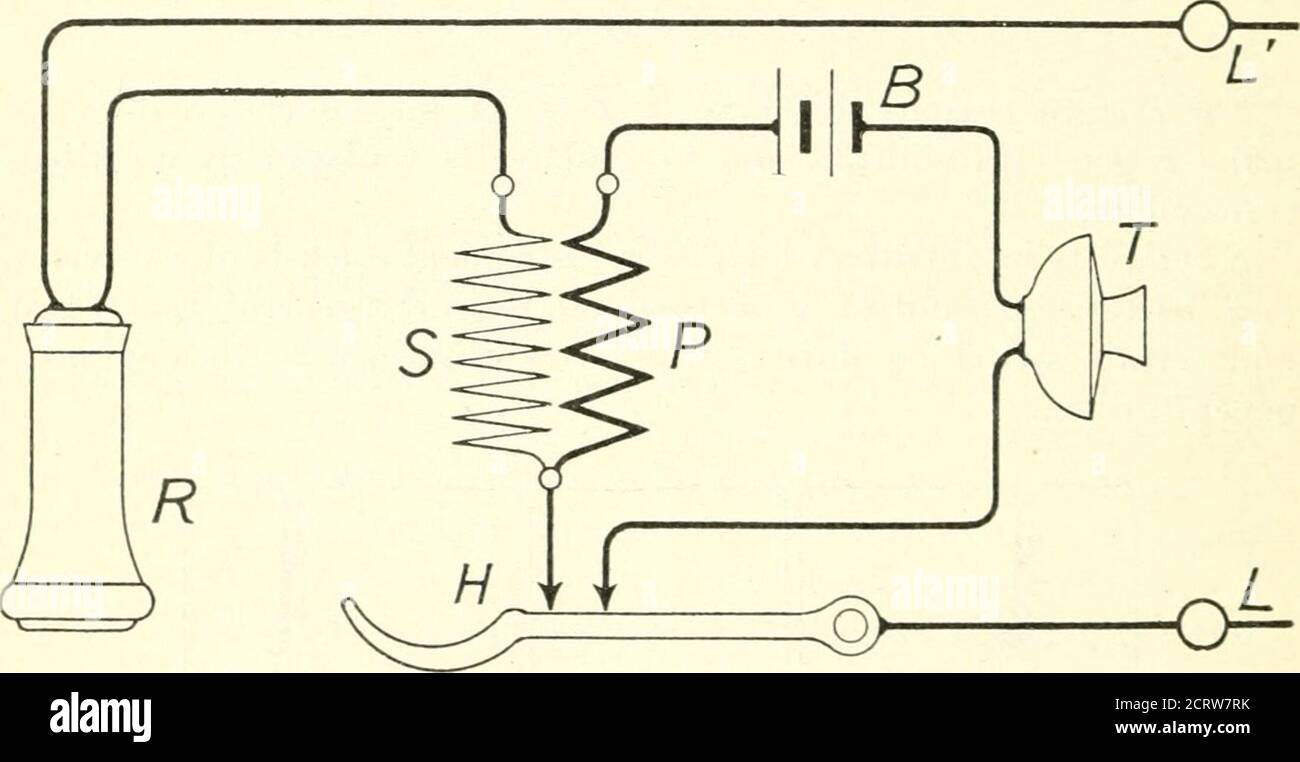
. Apparecchi elettrici e telefoni dei corpi di segnale degli Stati Uniti . 11 S 114 ELECTRICAL INSTRUMENTS U. S. SIGNAL CORPS. i-oiiultHl da due avvolgimenti di filo di rame insieUd, uno di filo grosso, con pochi giri e resistenza Ioav, chiamata primario, e l'altro di filo sottile, con un gran numero di spire e alta resistenza, chiamato secondario. La posizione relativa delle parti più disparate di uno strumento a batteria locale è indicata in figura 69, in cui T è il trasmettitore che contiene i granuli di carbonio attraverso i quali scorre la corrente proveniente dalla batteria B. T contiene anche un diaframma che p
2197 x 1137 px | 37,2 x 19,3 cm | 14,6 x 7,6 inches | 150dpi
Altre informazioni:
Questa immagine potrebbe avere delle imperfezioni perché è storica o di reportage.
. Electrical instruments and telephones of the U.S. Signal corps . —11 S 114 ELECTRICAL INSTRUMENTS U. S. SIGNAL CORPS. i-oiiiultHl by two windings of insiilaUd copper wire, one being ofcoarse wire, with few turns and Ioav resistance, called the primary, and the other of fine wire, with a large number of turns and higherresistance, called the secondary. The relative position of thesevarious parts of a local battery instrument is indicated in figure 69. inwhich T is the transmitter that contains the carbon granules throughwhich the current from battery B flows. T also contains a diaphragmwhich presses on the carbon granules, or is so connected with themas to vary the pressure between the particles as the sound waves fallon it. P is the coarse and S the fine Avire winding of the inductioncoil, which is connected to the receiver R and the line. The localbattery circuit includes B. P, IL and T. As the air vibrations fall onthe diaphragm at T they produce a change in the resistance betweenthe carbon particles in contact with it. This change of resistance. l-i<;. GO. causes the current flowing in llie coarse-wire coil to fiuciuaie. therebyinducing a fluctuating current in the fine-wire coil, which goes to theline and receiver and reproduces speech, as has been explained before. COMMON BATTERY TRANSMISSION. The common l)attery telephone operates like the local battery inits essential details. The principal point of difterence lies in thefact that in common battery operation the current Avhich flowsthrough the transmitter is furnished by battery installed at thecentral exchange in place of local battery installed in the instrument, as in the case of the local battery telephone. In the common batterytelephone battery is supplied over the same wires that are used fortransmitting speech. Figure TO shows the essential parts of thecommon battery instrument. The induction coil for this type of ELECTRICAL INSTRUMENTS U. S. SIGNAL CORPS. 115 instrument is usually provided with p