7976 x 5464 px | 67,5 x 46,3 cm | 26,6 x 18,2 inches | 300dpi
Data acquisizione:
29 giugno 2025
Ubicazione:
Dublin City Council Civic Offices, Wood Quay, Dublin 8, D08 RF3F
Altre informazioni:
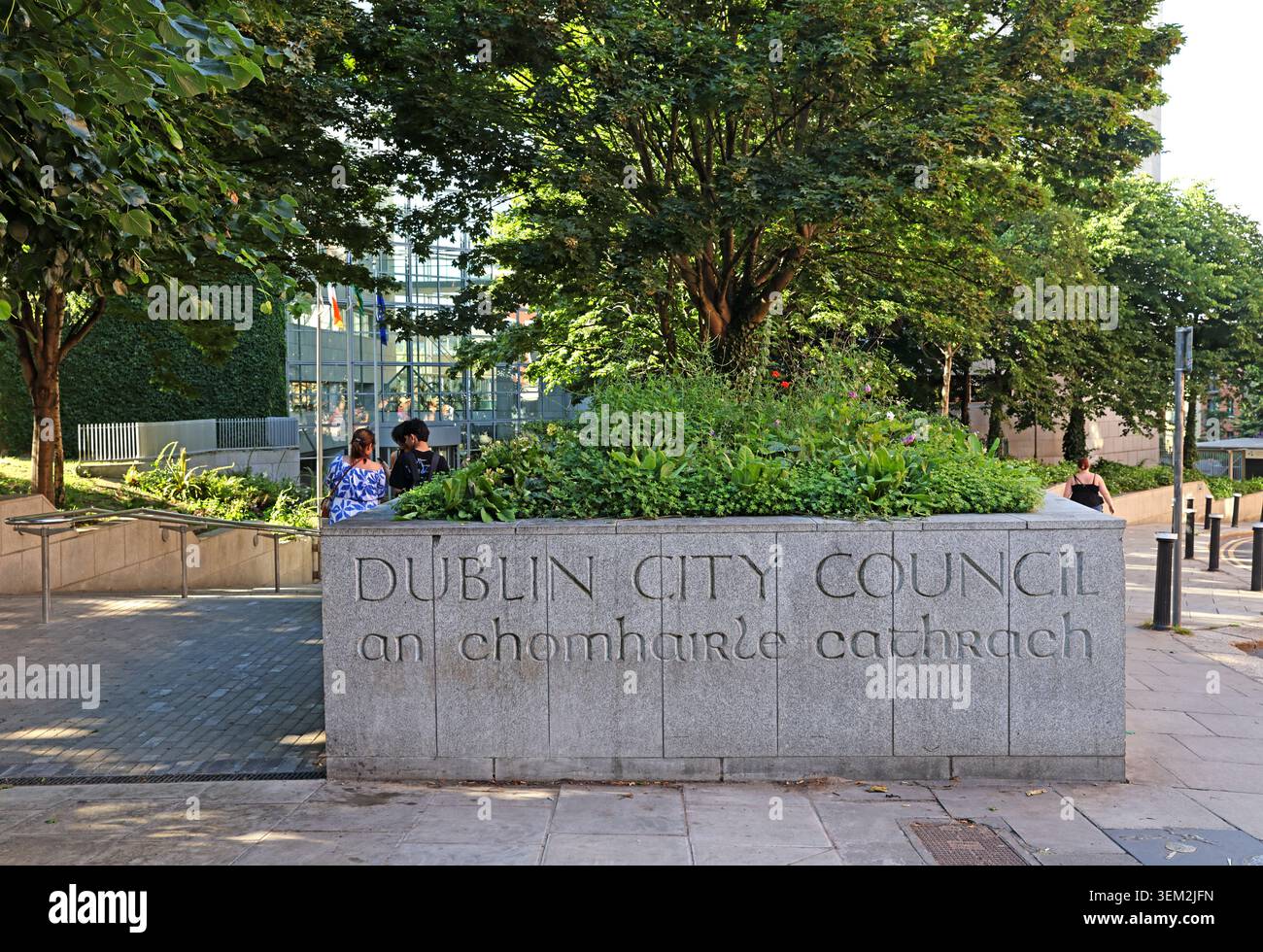
Bilingual stone nameplate marks the entrance to Dublin City Council’s Civic Offices at Wood Quay in Dublin 8. The carved inscription reads “Dublin City Council” and “an chomhairle cathrach”, set within a landscaped public space of mature trees, shrubs, paving, steps and seating. People rest in the shaded civic plaza, while the glazed office complex can be seen beyond the planting. Bright summer daylight, leafy surroundings and clear shadows create a calm urban scene at the administrative headquarters of Ireland’s capital city. Dublin City Council is the local authority responsible for municipal services across the city, including housing, planning, roads, waste management, libraries, parks, culture, fire services and public-realm functions. The Wood Quay complex accommodates customer services, council departments, elected-member functions, meetings and public facilities. Its bilingual identity reflects the use of both English and Irish in civic administration. Wood Quay is one of Dublin’s most historically significant and controversial urban sites. Archaeological excavations during the 1970s uncovered remains of the Hiberno-Norse Viking settlement, including houses, streets, workshops, artefacts and sections of the medieval city defences. Plans to build the civic headquarters prompted the major Save Wood Quay campaign, including a large protest march in 1978. Construction of the first granite-clad office blocks, designed by architect Sam Stephenson, was completed during the 1980s. A later phase by Scott Tallon Walker added a more transparent public entrance using Wicklow granite, glass and a four-storey portico. This photograph is suitable for editorial coverage of Dublin local government, municipal administration, bilingual public signage, Irish civic identity, public offices, urban landscaping, architectural debate, Viking archaeology, heritage conservation and the relationship between modern government buildings and historic city sites.