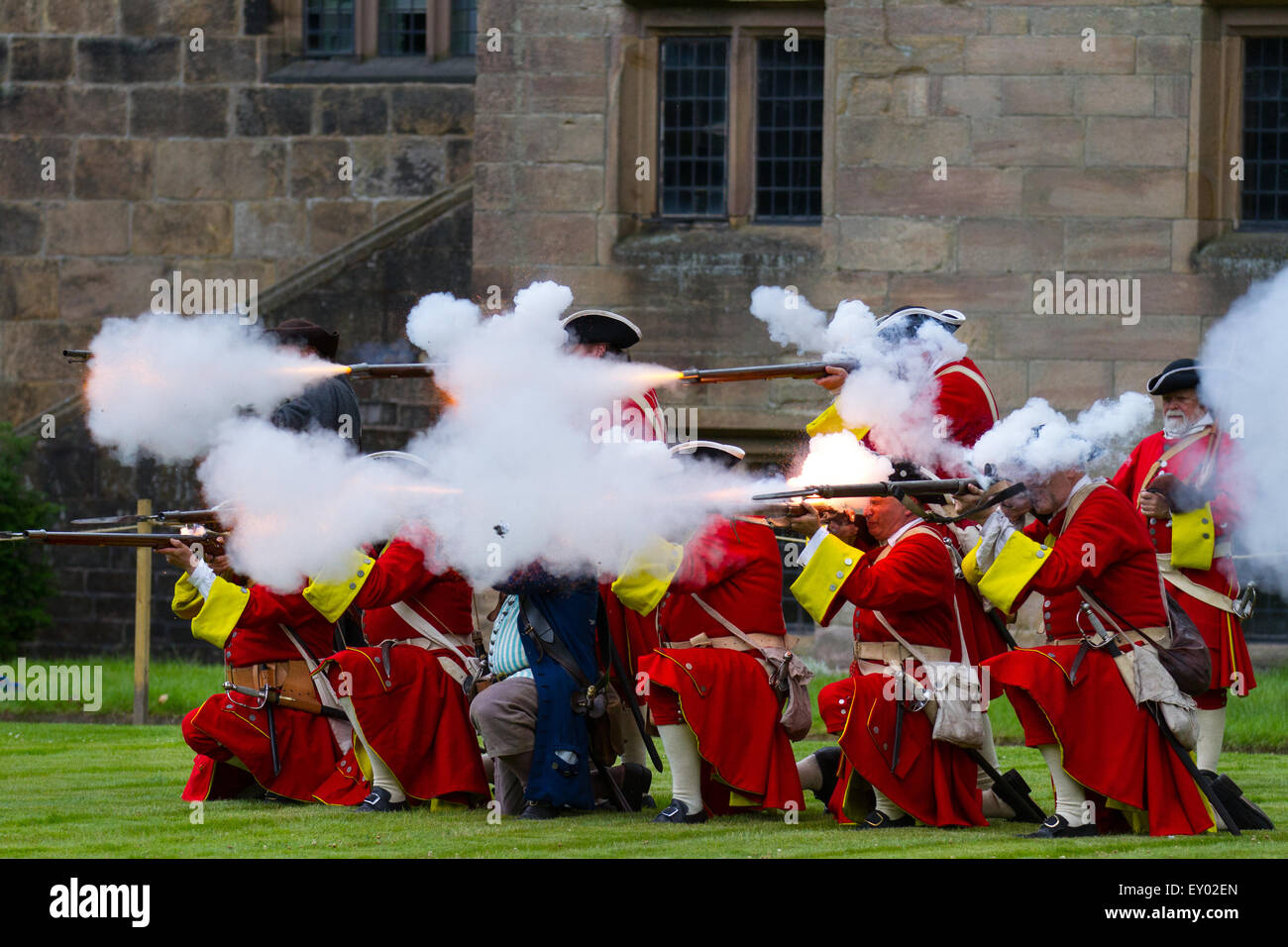
Fuoco di muschio, fuoco di polvere nera a Hoghton, Preston, Lancashire, Regno Unito. 18 luglio 2015. The Queen's Royal Regiment Living History Group con British Red Cappotti dell'esercito inglese, sparando e sparando muschi alla Battaglia di Preston – l'ultima battaglia sul suolo inglese. Quest'anno si celebra il 300° anniversario e un momento decisivo nella prima risata dei giacobiti britannici. La battaglia di Preston (9–14 novembre 1715), detta anche lotta di Preston, 1715 spesso chiamata la prima rivolta giacobita, o ribellione da parte dei sostenitori del governo anoviano.
4632 x 3088 px | 39,2 x 26,1 cm | 15,4 x 10,3 inches | 300dpi
Data acquisizione:
18 luglio 2015
Ubicazione:
Hoghton, Preston, Lancashire, UK.
Altre informazioni:
Questa immagine potrebbe avere delle imperfezioni perché è storica o di reportage.
The Jacobites moved south into England with little opposition, and by the time they reached Preston in Lancashire had grown to about 4, 000 in number. Their horse troops entered Preston on the night of 9 November 1715, and as they approached two troops of dragoons and part of a militia regiment retreated to Wigan. General Charles Wills was ordered to halt their advance, and left Manchester on 11 November with six regiments, arriving on the 12th. The Jacobite leader Thomas Forster, a Northumberland squire, had intended to move on that day, but, learning of Wills's approach, decided to stay and made the mistake of withdrawing troops from a strong defensive position at Ribble bridge, 0.5 miles (0.80 km) outside Preston. The Jacobites had barricaded the principal streets of Preston, and Wills ordered an immediate attack, which met with fire from the barricades and from houses, resulting in the Hanoverian attack being repulsed with heavy losses. Wills then had houses set on fire, with the aim of fires spreading along to the Jacobite positions, and the Jacobites tried to do the same to houses taken as government positions. At night, Wills's order to light the government-held positions for identification helped the Jacobite snipers, but overnight many Jacobites left the town. The legend of these actions is recounted in a well-known Lancashire ballad, Lo! The Bird is Fallen. On the morning of Sunday 13 November more government forces arrived and, finding that the town was insufficiently encircled, Wills stationed more troops to prevent the besieged Jacobite army from escaping. Seventeen Jacobites were killed and twenty-five wounded. Government casualties were close to 300 killed and wounded. Of the ordinary Highland clansmen defeated at the Battle of Preston, many were transported to the Americas.