Questa immagine potrebbe avere delle imperfezioni perché è storica o di reportage.
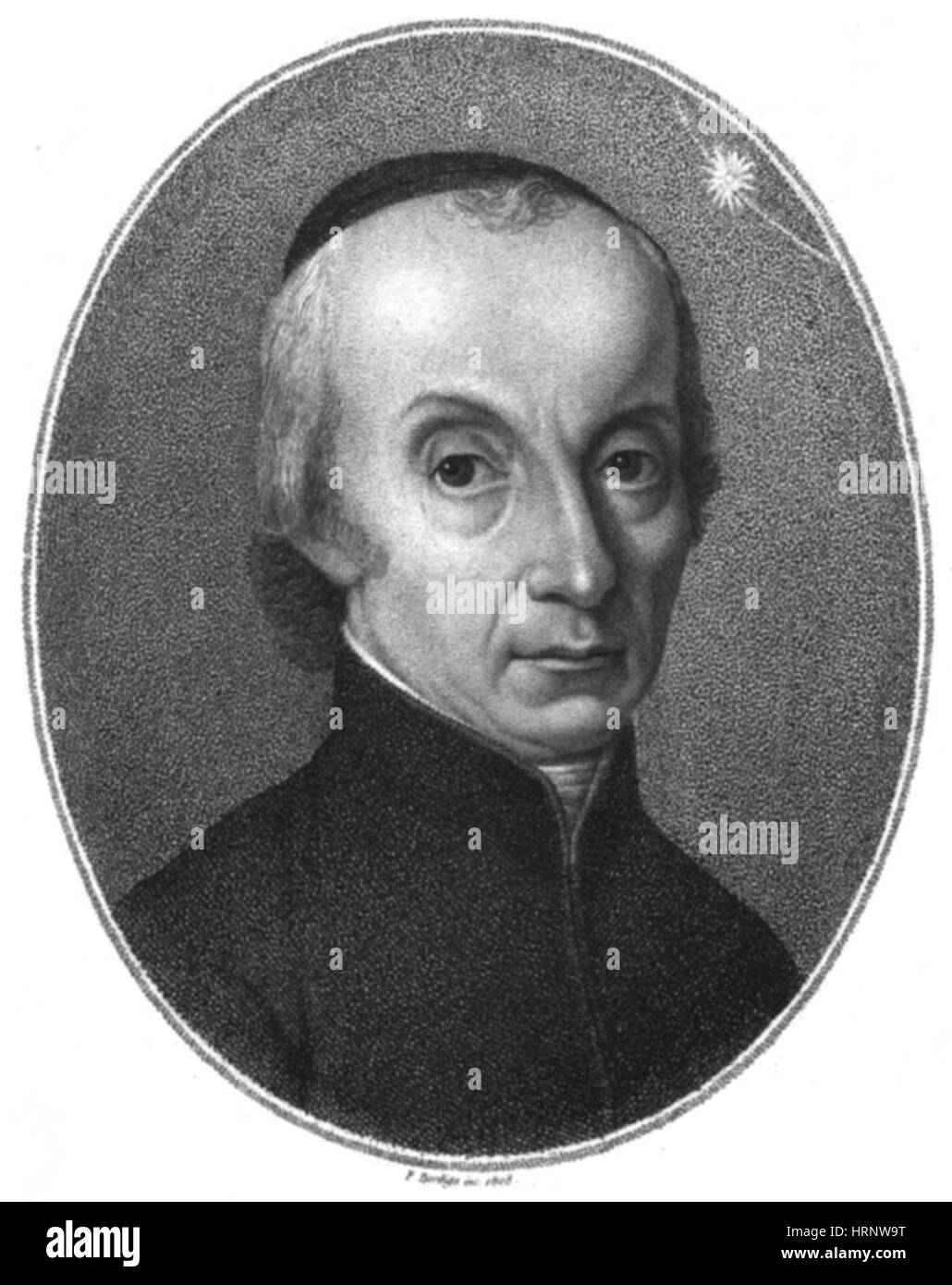
Giuseppe Piazzi (July 16, 1746 - July 22, 1826) was an Italian Catholic priest of the Theatine order, mathematician, and astronomer. No documented account of his scientific education is available in any of the biographies. He held the chair and/or lectured on mathematics at various universities in Italy throughout the 1770s and 1780's. In 1787, when he became Professor of Astronomy at the University of Palermo. He spent two years in pros in London to get instruments specially built for the Palermo Observatory, whose foundation he was in charge of. He supervised the compilation of the Palermo Catalogue of stars, containing 7, 646 star entries with unprecedented precision. On New Year's Day in 1801, he discovered a stellar object that moved against the background of stars. He became convinced it was a planet, or as he called it, "a new star", but he took the conservative route and announced it as a comet. He was not able to observe it long enough as it was soon lost in the glare of the Sun. Unable to compute its orbit with existing methods, the renowned mathematician Carl Friedrich Gauss developed a new method of orbit calculation that allowed astronomers to locate it again. After its orbit was better determined, it was clear that his assumption was correct and this object was not a comet but more like a small planet. He named it, Ceres Ferdinandea, after the Roman goddess of grain and King Ferdinand IV of Naples and Sicily. Ceres turned out to be the first, and largest, of the asteroids existing within the asteroid belt. Ceres is today called a dwarf planet. He died in 1826 at the age of 80.