5690 x 4299 px | 48,2 x 36,4 cm | 19 x 14,3 inches | 300dpi
Data acquisizione:
10 aprile 2016
Ubicazione:
RAF Lossiemouth Moray Grampian Region North East Scotland UK
Altre informazioni:
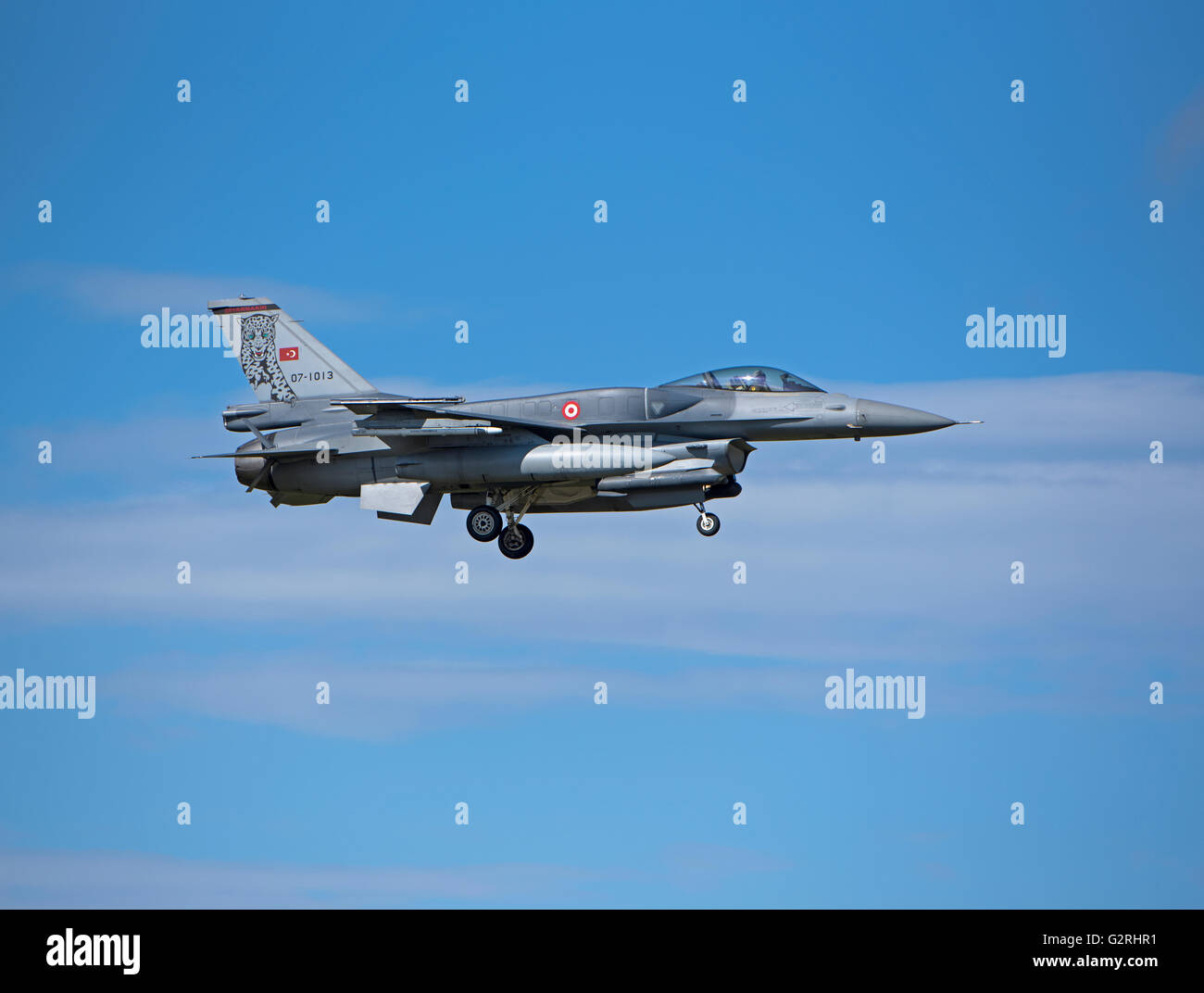
In 1984 Turkish Aerospace Industries (TAI) was established and Turkey started to produce fighter aircraft locally under license, including a total of 232 F-16 Fighting Falcon (Block 30/40/50) aircraft for the air force. The air force had previously received 8 F-16s that were purchased directly from the United States, bringing the total number of F-16s received by the air force to 240. TAI is currently building 30 new F-16 Block 50+ aircraft for the TuAF and is applying a CCIP upgrade on the existing fleet of Block 30/40/50 F-16s, which will bring all of them to the Block 50+ standard.Dozens of TAI-built F-16s were also exported to other countries, particularly in the Middle East. A total of 46 TAI-built F-16s have been exported to theEgyptian Air Force under the Peace Vector IV Program (1993–1995), making it TAI's second-largest F-16 customer after the Turkish Air Force. Turkey is one of only five countries in the world which locally produce the F-16 Fighting Falcon.Alternate Fighter Engine (AFE) program (colloquially known as "the Great Engine War"), which also saw the entry of General Electric as an F-16 engine provider. Its F110-GE-100 turbofan was limited by the original inlet to thrust of 25, 735 lbf (114.5 kN), the Modular Common Inlet Duct allowed the F110 to achieve its maximum thrust of 28, 984 lbf (128.9 kN). (To distinguish between aircraft equipped with these two engines and inlets, from the Block 30 series on, blocks ending in "0" (e.g., Block 30) are powered by GE, and blocks ending in "2" (e.g., Block 32) are fitted with Pratt & Whitney engines.) The Increased Performance Engine (IPE) program led to the 29, 588 lbf (131.6 kN) F110-GE-129 on the Block 50 and 29, 160 lbf (129.4 kN) F100-PW-229 on the Block 52. F-16s began flying with these IPE engines in the early 1990s.