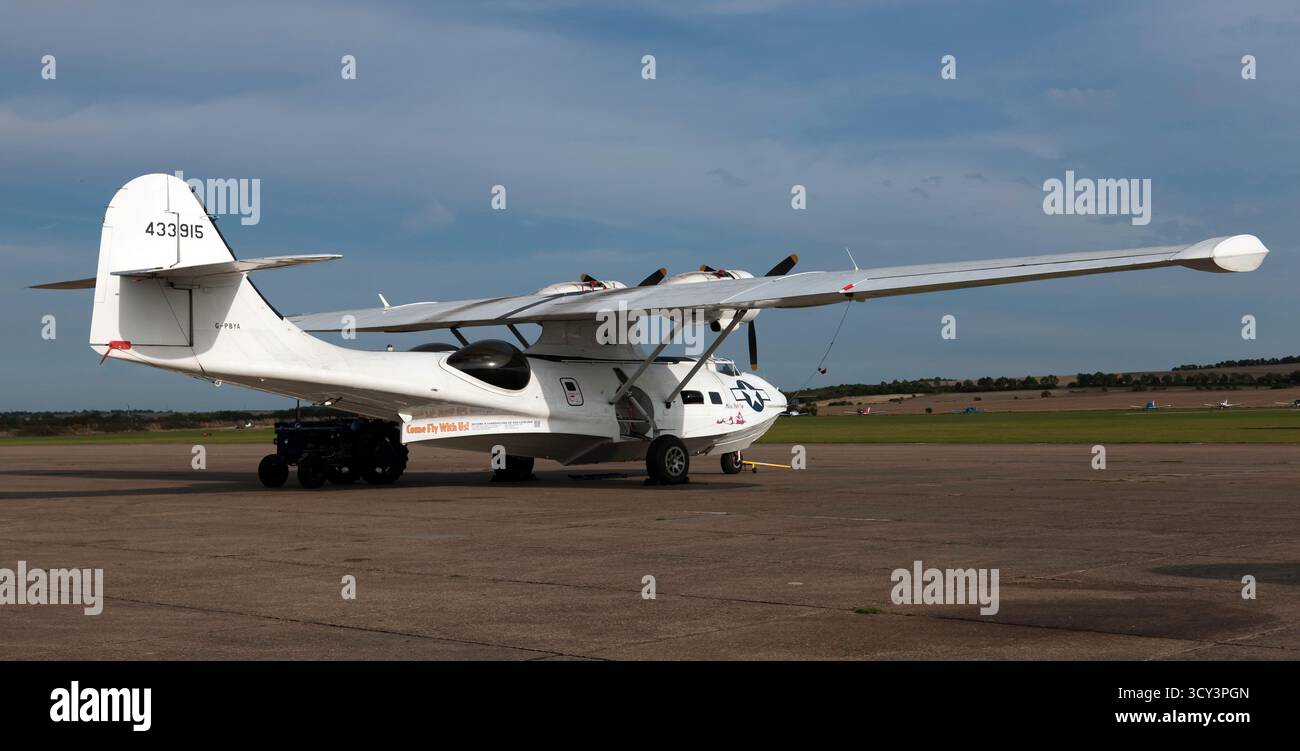
5452 x 2774 px | 46,2 x 23,5 cm | 18,2 x 9,2 inches | 300dpi
Data acquisizione:
6 settembre 2025
Ubicazione:
IWM Duxford, Cambridgeshire, CB22 4QR
Altre informazioni:
G-PBYA was originally ordered for the Royal Canadian Air Force as a Canso A amphibian, basically equivalent to the US Navy PBY-5A. It was built by Canadian Vickers at Cartierville, Quebec and was allocated their constructors number CV-283 before adopting the RCAF serial 11005. It was taken on charge by the air force on 27 October 1943 and initially saw service with 9 (Bomber Reconnaissance) Squadron at Bella Bella on the British Columbia coast between Vancouver and Prince Rupert. It was on their inventory from November to the following August. 9 Squadron had been based at Bella Bella for some time prior to the arrival of Cansos, having operated Supermarine Stranraers there. The Cansos were mainly operated from water despite their amphibious undercarriages and were used on day and night patrols, looking out for enemy submarines. By mid-1944, the threat of a Japanese invasion of Western Canada had receded and it was decided to disband 9 Squadron and close the station at Bella Bella. The Cansos, including 11005, were flown to Alliford Bay in the Queen Charlotte Islands, also in British Columbia, and transferred to 7 (BR) Squadron in August. The job was the same – anti-submarine patrols mostly – and 11005 remained with 7 Sqn until it too was disbanded on 25 July 1945. During this period of 11005’s service, it would have flown with an overall matt white hull and upper surfaces, the lower hull being gloss white. C-FNJF had reached Shannon in the early hours of 30th March and, after a few hours rest, the crew of Paul Warren Wilson, Rod Brooking and Garry Short flew on to home at Duxford, to be met by a small band of dedicated crew and supporters, almost outnumbered by representatives form the aviation press, radio and TV! Following its triumphant arrival at Duxford, C-FNJF flew at a good number of airshows during the 2004 season, its first being a long flight down to Biscarosse in south-west France where it not only performed impeccably in the air