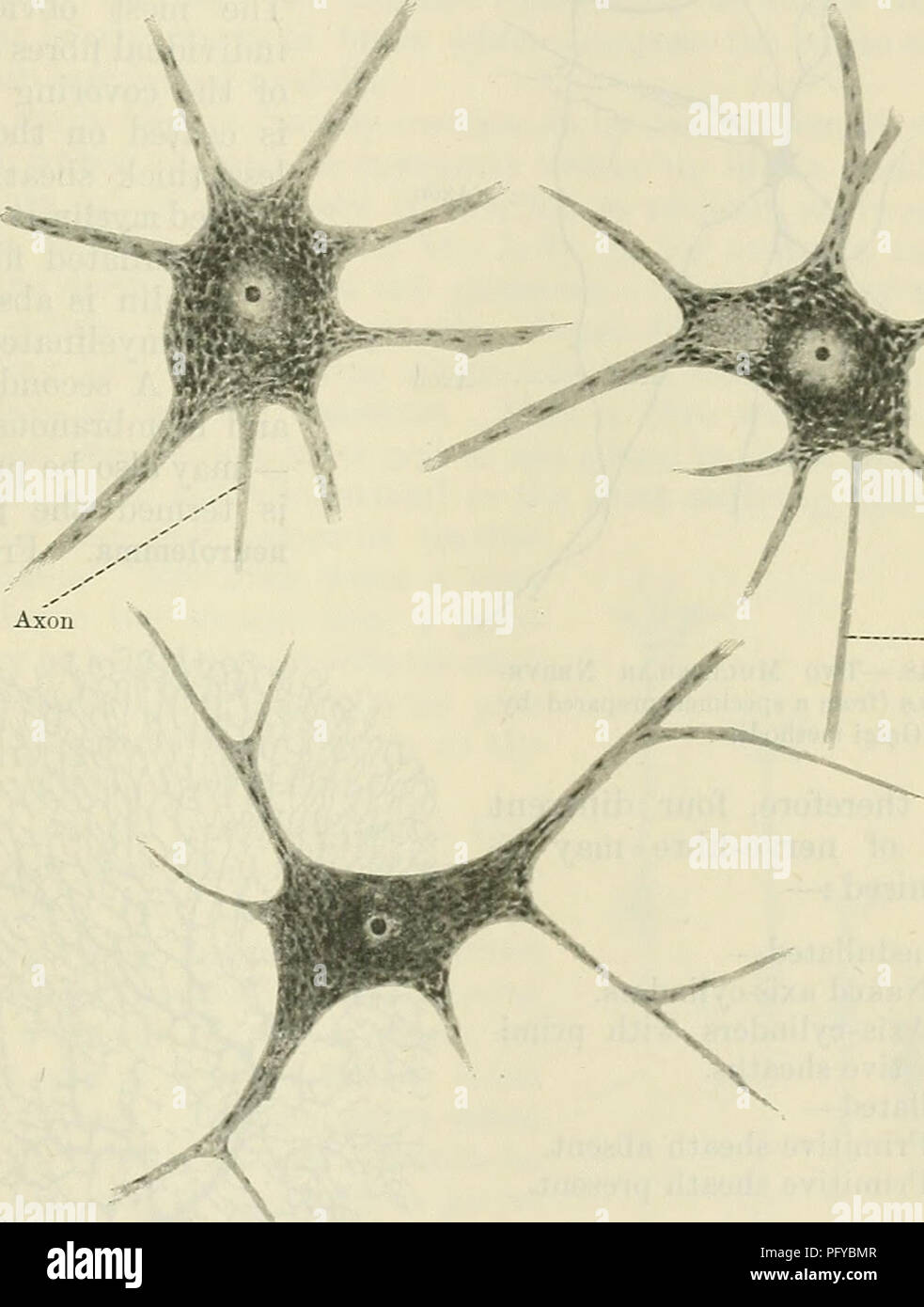
Il *Text-book of Anatomy* di Cunningham fornisce un'esplorazione approfondita delle cellule del sistema nervoso, inclusa la differenziazione dei neuroni, la struttura delle cellule nervose nel cervello e nella midollare spinale, e le loro diverse dimensioni e funzioni. Il testo è una risorsa completa per coloro che studiano anatomia umana e neurobiologia.
1375 x 1817 px | 23,3 x 30,8 cm | 9,2 x 12,1 inches | 150dpi
Altre informazioni:
Questa foto è un'immagine di pubblico dominio, il che significa che il copyright è scaduto o che il titolare del copyright ha rinunciato a tale diritto. Alamy addebita un costo per l'accesso alla copia ad alta risoluzione dell'immagine.
Questa immagine potrebbe avere delle imperfezioni perché è storica o di reportage.
. Cunningham's Text-book of anatomy. Anatomy. NEKVE-CELLS. 507 found in the rest of the nervous system. They differ not only in their mode of origin and in their subsequent development, but also in the connexions of their nerve-fibre processes. Nerve-cells of the Brain and Spinal Medulla.—The cells in the cerebro- spinal axis are variable both in size and form. Some are relatively large, as, for example, certain of the pyramidal cells of the cerebral cortex and the motor cells in the spinal medulla, which almost come within the range of unaided vision; others are exceedingly minute, and require a high power of the microscope to bring them into view. The cell consists of a protoplasmic nucleated body, from which the axon proceeds, and the protoplasmic processes of Deiters, or the dendrites (Fig. 447). The axon presents a uniform diameter and a smooth and even outline. It gives off in its course fine collateral branches, but does not suffer thereby any marked diminution in its girth. The most important point to note in connexion with the axon, how- ever, is the fact that it becomes continu- ous with the axis- cylinder of a nerve- fibre. The axon then is simply a nerve-fibre, and in certain circum- stances it assumes one or two invest- ing sheaths, of which more will be said later. The axon may run its entire course within the substance of the brain or spinal medulla, either for a short or a long dis- tance (intercalated cells), or it may emerge from the brain or spinal medulla in one of the cerebral or spinal nerves as the essential part of an efferent nerve-fibre, and run a variable distance before it finally reaches the peripheral structure in relation to which it ends (efferent nerve-cells). The axon and the collaterals which spring from it appear to terminate either in small button-like swellings or knobs, or more frequently in terminal arborisations, the extremities of which seem to be furnished with ex- ceedingly small terminal varicosities. In those cases whe