. Il transito di Venere, che indaga su matematici successivi ci hanno permesso di predire, con meravigliosa precisione, le posizioni future dei pianeti. Ma le dimensionidel sistema solare non sono note con la sameprecisione. È vero che conosciamo le distanze relative dei pianeti allthel dal sole con esattezza tollerabile.questo problema è stato attaccato da due metodi totalmente diversi. Il primo consiste nel misurare direzionei cambiamenti che sono prodotti nei movimenti dei pianeti quando la terra si è mossa attraverso una certa parte della sua orbita. Nel caso dei pianiMercurio AN
1566 x 1595 px | 26,5 x 27 cm | 10,4 x 10,6 inches | 150dpi
Altre informazioni:
Questa foto è un'immagine di pubblico dominio, il che significa che il copyright è scaduto o che il titolare del copyright ha rinunciato a tale diritto. Alamy addebita un costo per l'accesso alla copia ad alta risoluzione dell'immagine.
Questa immagine potrebbe avere delle imperfezioni perché è storica o di reportage.
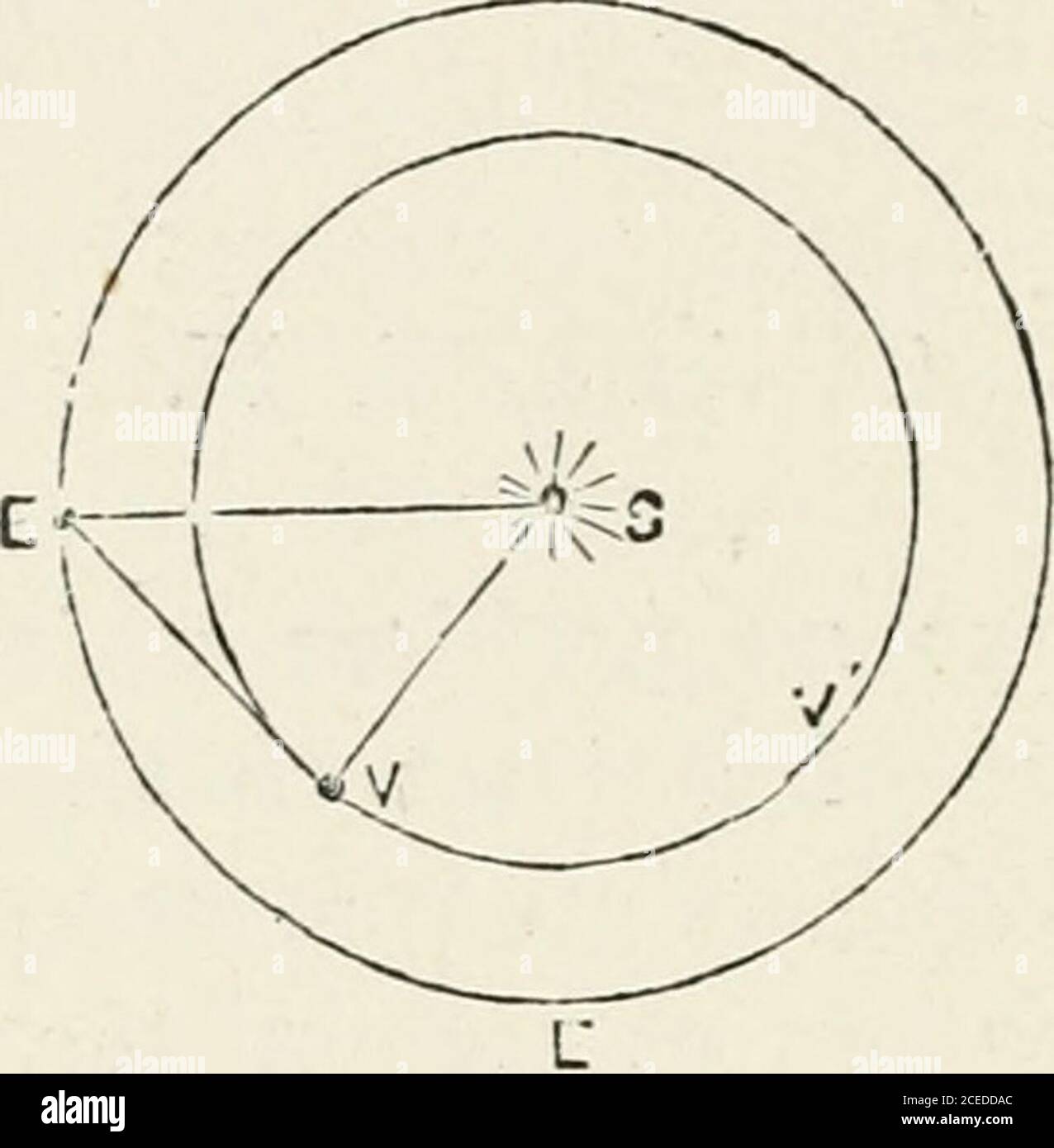
. The transit of Venus. he investigations of later mathematicians have en-abled us to predict, with wonderful accuracy, thefuture positions of the planets. But the dimensionsof the solar system are not known with the sameprecision. It is true that we know the relative distances of allthe planets from the sun with tolerable exactness.This problem has been attacked by two totally differ-ent methods. The first consists in measuring directlythe changes that are produced in the motions of theplanets when the earth has moved through a certainportion of its orbit. In the case of the planetsMercury and Venus, which move in smaller orbitsthan that of the earth, the direct observation caneasily be made. For let us suppose w and EE i6 THE TRANSIT OF VEALS. [chap. (Fig. 8) to be the orbits of Venus and the Earth, andS to be the sun. Let us watch the position of Venusnight after night until she is as far away from thesun as possible. If we measure her apparent dis-tance from the sun by astronomical means, we shall f/g. a. know that the Sun, Venus, and the Earth occupypositions such as S, V, and E ; the directions ES andE V being known from our observations. By measur-ing off the distances S V and S E on the diagram, weactually find the relation between the earths distancefrom the sun and that of Venus. The same can bedone with Mercury ; but for the superior planets thedirect mode of observation is more difficult. But there is an indirect method which is muchmore easy to apply. Keplers three laws have beenshown to be necessary consequences of Newtonstheory of gravitation. Now Keplers third law tellsus how to find the relative distances of two planetsfrom the sun when we know the relation betweentheir periods of revolution. The exact law is this :— Multiply the number of years taken by a planet , IL] THE TRANSIT OF VENUS. 17 to go round the sun, by the same number. Thisgives us a first number. Then find a second numberwhich, multiplied by itself twice, gives us the firstnumber; t