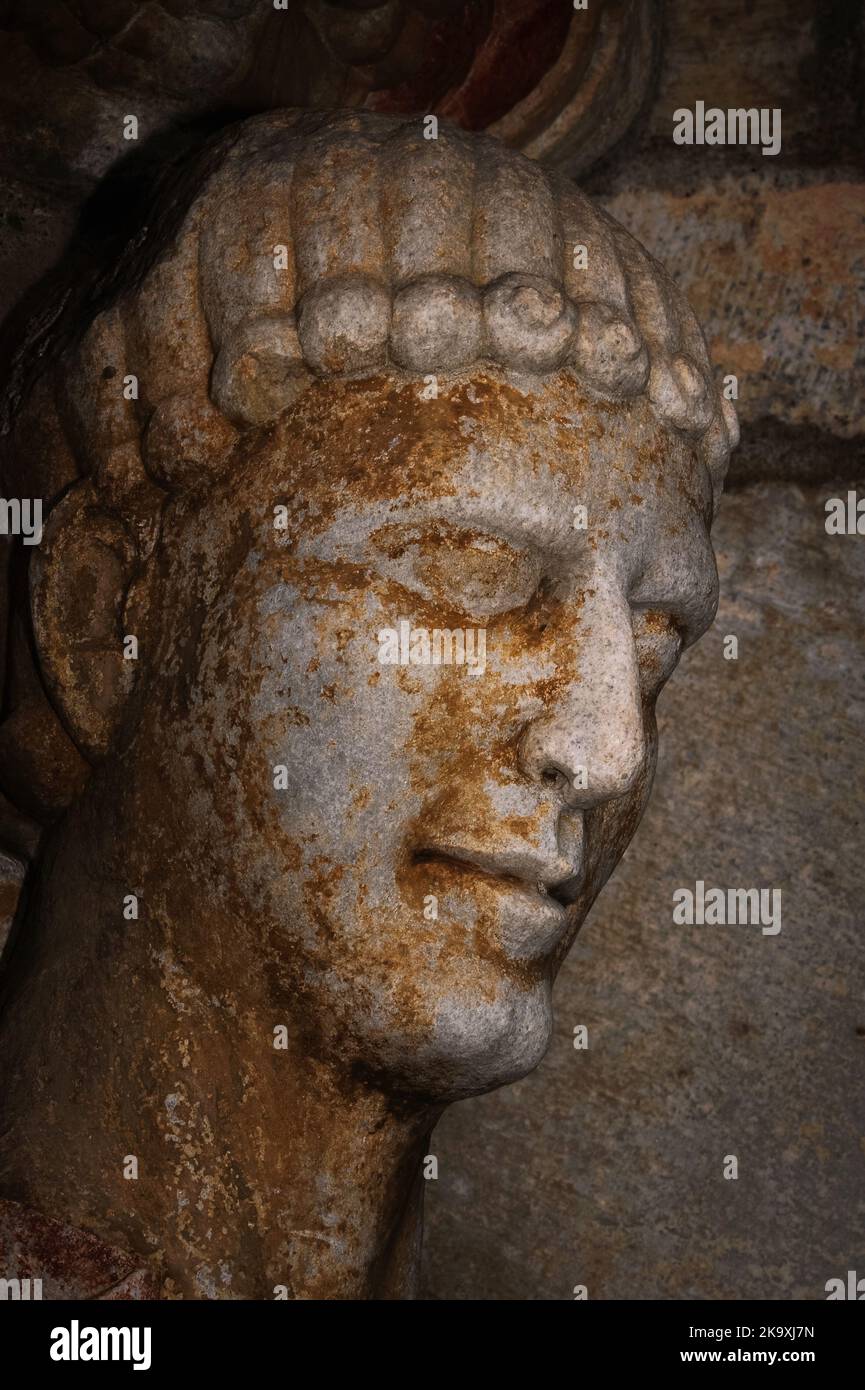
Il volto di Santo Stefano, il primo martire cristiano, lapidato a morte dopo aver denunciato i suoi giudici. Dettaglio della statua a colonna romanica di fine 1100s nel portale nord della Basilique Saint-Just, consacrata nel 1200 a Valcabrère in Occitanie, sud-ovest della Francia. Una capitale scolpita sopra la testa di Stefano raffigura il suo martirio.
2832 x 4256 px | 24 x 36 cm | 9,4 x 14,2 inches | 300dpi
Data acquisizione:
23 dicembre 2007
Ubicazione:
Basilica of St Just, Valcabrère, Occitanie, France
Altre informazioni:
Questa immagine potrebbe avere delle imperfezioni perché è storica o di reportage.
Valcabrère, Occitanie, France: the face of Saint Stephen, the first Christian martyr, on his pillar statue in the north portal of the Romanesque Basilique Saint-Just-de-Valcabrère (Basilica of St Just). The austere late-1100s pillar statue, bearing remains of ancient colouring, stands below a sculpted Romanesque capital depicting his death by stoning. According to the New Testament Acts of the Apostles, Stephen was a deacon in the early church at Jerusalem whose teaching angered members of various synagogues. He was accused of blasphemy and was condemned to be stoned to death after denouncing his Jewish judges. Saul of Tarsus, later known as St Paul the Apostle, was present at Stephen's martyrdom. The north portal also includes pillar statues and sculpted capitals of St Helena of Constantinople and of St Pastor and St Just or Justus, two schoolboy brothers, martyred by the Romans in Spain, who became the basilica’s joint patron saints. According to legend, St Pastor, 13, and St Just or Justus, seven, were arrested and beheaded after confessing to the Roman governor that they were Christians who would not sacrifice to idols. The basilica, a superb example of Romanesque architecture, stands apart from the village of Valcabrère in the Garonne Valley, below and about 1 km east of the village of Saint-Bertrand-de-Comminges with its Romanesque and Gothic former cathedral. It was built on the burial ground or necropolis of the ancient Roman settlement of Lugdunum Convenarum, re-using many Gallo-Roman architectural fragments. D1146.B3684