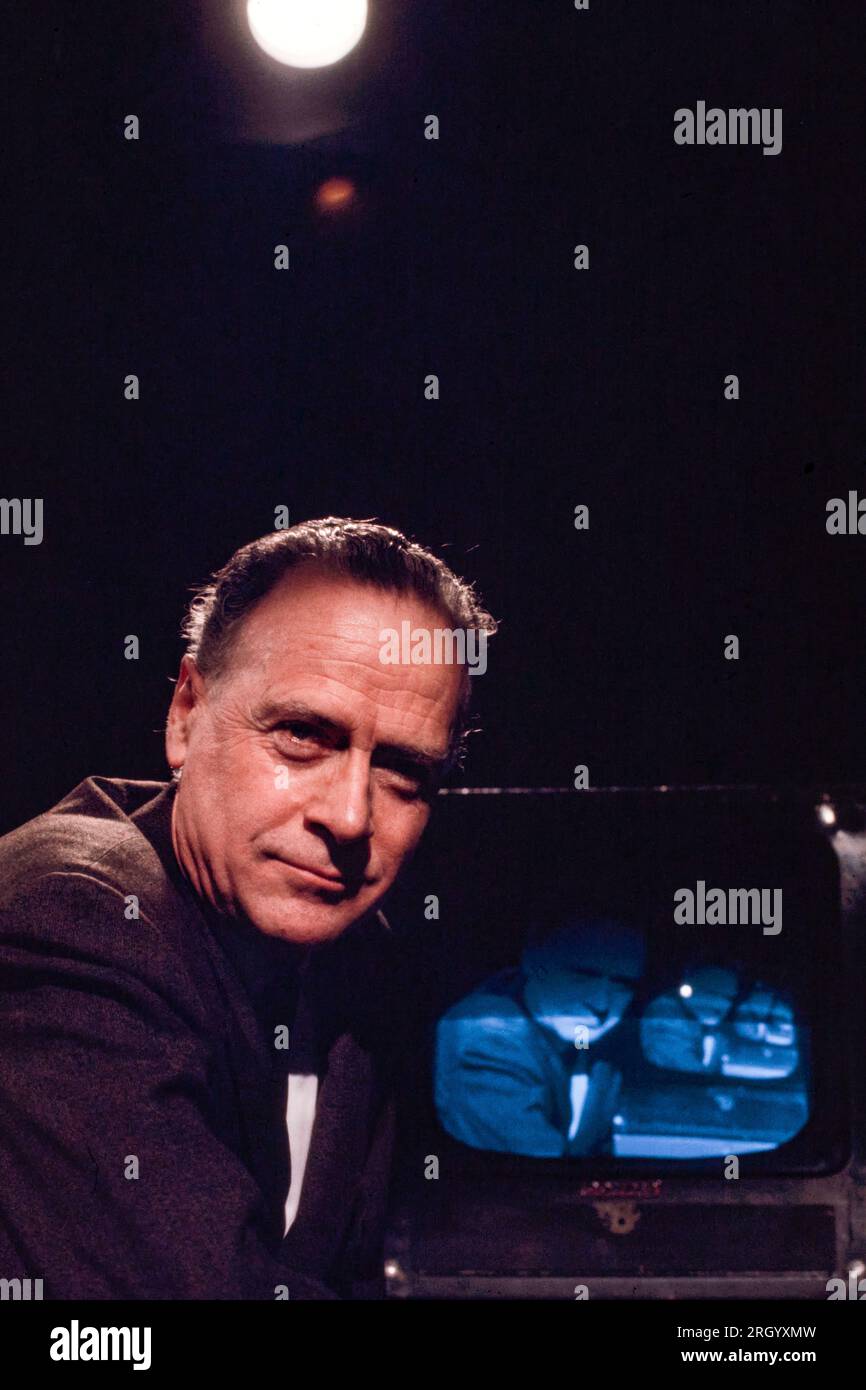
Marshall McLuhan - con set televisivo - è stato un filosofo canadese il cui lavoro è tra le pietre miliari dello studio della teoria dei media. Ha studiato presso l'Università di Manitoba e l'Università di Cambridge. Iniziò la sua carriera di insegnante di inglese in diverse università negli Stati Uniti e in Canada prima di trasferirsi all'Università di Toronto nel 1946, dove rimase per il resto della sua vita. McLuhan ha coniato l'espressione "il mezzo è il messaggio" nel primo capitolo della sua comprensione dei media. Fotografia di Bernard Gotfryd
6316 x 9472 px | 53,5 x 80,2 cm | 21,1 x 31,6 inches | 300dpi
Data acquisizione:
20 agosto 2020
Ubicazione:
Toronto, Canada
Altre informazioni:
Questa immagine potrebbe avere delle imperfezioni perché è storica o di reportage.
McLuhan's most widely-known work, Understanding Media: The Extensions of Man (1964), is a seminal study in media theory. Dismayed by the way in which people approach and use new media such as television, McLuhan famously argues that in the modern world "we live mythically and integrally…but continue to think in the old, fragmented space and time patterns of the pre-electric age."[67] McLuhan proposed that media themselves, not the content they carry, should be the focus of study—popularly quoted as "the medium is the message." McLuhan's insight was that a medium affects the society in which it plays a role not by the content delivered over the medium, but by the characteristics of the medium itself. McLuhan pointed to the light bulb as a clear demonstration of this concept. A light bulb does not have content in the way that a newspaper has articles, or a television has programs, yet it is a medium that has a social effect; that is, a light bulb enables people to create spaces during nighttime that would otherwise be enveloped by darkness. He describes the light bulb as a medium without any content. McLuhan states that "a light bulb creates an environment by its mere presence."[68] More controversially, he postulated that content had little effect on society—in other words, it did not matter if television broadcasts children's shows or violent programming, to illustrate one example—the effect of television on society would be identical.[69] He noted that all media have characteristics that engage the viewer in different ways; for instance, a passage in a book could be reread at will, but a movie had to be screened again in its entirety to study any individual part of it.