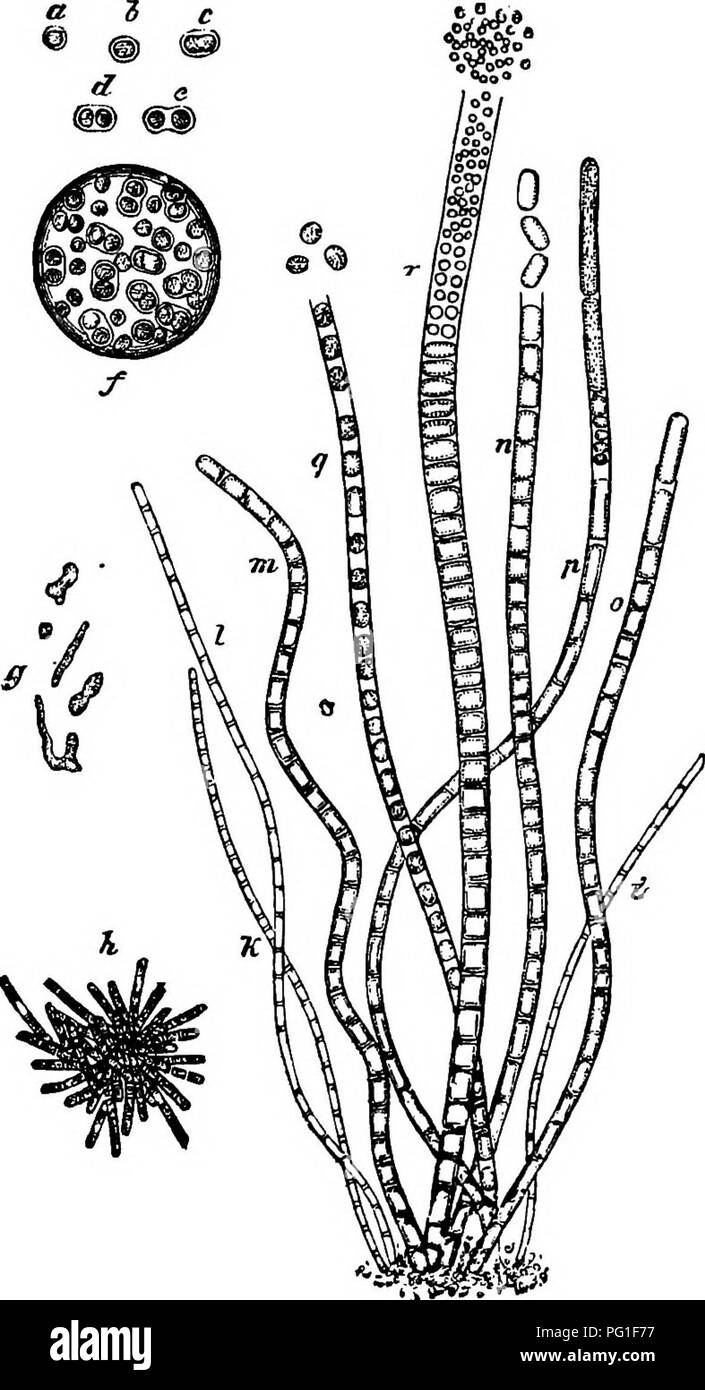
. Morfologia comparata e della biologia dei funghi, mycetozoa e batteri . Morfologia vegetale; funghi; Myxomycetes; batteriologia. 470 TERZA PARTE.-BATTERI O SCHIZOMYCETES. "'4?- diventare aggregate nell'acqua in masse viscido un piede in profondità. La questione gelatinoso è inizialmente incolore, ma può assumere un colore che varia dal rosso mattone al marrone scuro dalla miscela di ossido idrato di ferro. Quando coltivate in bog-acqua i cocci sviluppare in aste o filamenti (h) della disparità di spessore, che ad una certa età diventano investito con un continuo sottile ma ferma guaina gelatinosa con la stessa miscela
1165 x 2146 px | 19,7 x 36,3 cm | 7,8 x 14,3 inches | 150dpi
Altre informazioni:
Questa foto è un'immagine di pubblico dominio, il che significa che il copyright è scaduto o che il titolare del copyright ha rinunciato a tale diritto. Alamy addebita un costo per l'accesso alla copia ad alta risoluzione dell'immagine.
Questa immagine potrebbe avere delle imperfezioni perché è storica o di reportage.
. Comparative morphology and biology of the fungi, mycetozoa and bacteria . Plant morphology; Fungi; Myxomycetes; Bacteriology. 470 THIRD PART.—BACTERIA OR SCHIZOMYCETES. "'4?- become aggregated in the water into slimy masses a foot in depth. The gelatinous matter is at first colourless, but may assume a colour varying from brick-red to dark brown by admixture of hydrated oxide of iron. When grown in bog-water the cocci develope into rods or filaments (h) of unequal thickness, which at a certain age become invested with a continuous thin but firm gelatinous sheath with the same admixture of iron as is found in the jelly of the zoogloea-forms. The single rod-like cells within their sheaths pass by repeated transverse bi- partitions into the form of nearly isodiametric mem- bers, which then round themselves off. The mem- bers in the thicker filaments often assume a flat disk-like shape, and then divide into 2-4 small cells by walls parallel to the longitudinal a.is of the filament. Both these cells and the rounded members of the slenderer filaments ultimately escape in the form of cocci from die sheath, being set free partly by the swelling of the sheath along its whole length, partly by its rupture at the apex (r). In the latter case some of the cocci slip of themselves out of the opening in the sheath, while others are passively thrust out of it by the growth in length of the other parts which remain in the sheath. The cocci may, though they rarely do, become motile, and pass again out of this state into the resting zoo- gloea-form; they also de- velope once more into rods and filaments in the manner which has already been described. In addition to these forms curved spirilla-like forms are also found, which may also break up into pieces, but without passing, as far as has been at present observed, into the motile state.. FIG. 196, C^enotbrv kiihttiana. a—^ct^dorspores. r—f cocci divldlnfr. /"cocci collected into a group and connected together by a