5616 x 3744 px | 47,5 x 31,7 cm | 18,7 x 12,5 inches | 300dpi
Data acquisizione:
22 ottobre 2024
Ubicazione:
ExCeL London, One Western Gateway, Royal Victoria Dock, London, E16 1XL
Altre informazioni:
Questa immagine potrebbe avere delle imperfezioni perché è storica o di reportage.
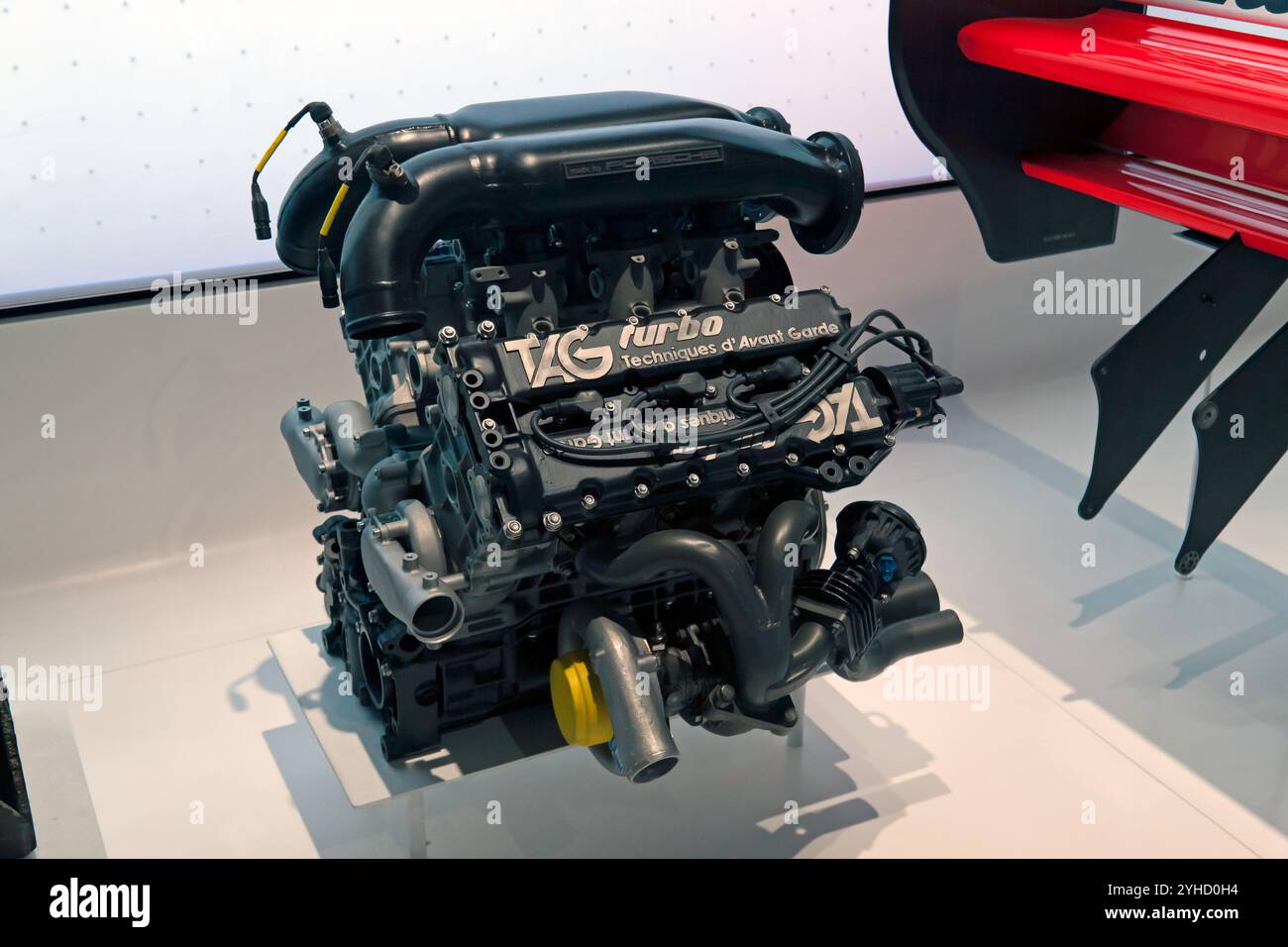
Build around an aluminum block it featured bombproof titanium connecting rods, forged pistons, and Nikasil (nickel-silicon) wet liners inside the cylinder walls to reduce friction. It employed overlapping rod throws on opposing cylinders which lowered fuel consumption, crankcase vibration, as well as oil pressure. The one-piece aluminum heads incorporated two overhead cams that operated twin intake and exhaust valves at a narrow 30-degree angle. The twin turbochargers were supplied by German manufacturer Kühnle, Kopp & Kausch (KKK), who at the time proved it could develop more reliable units than their American rivals Garrett. Furthermore, the innovative cooling system had a vast amount of cooling channels around the valve seats and other unconventional areas of the engine that significantly improved temperature management. The fuel system was mechanically controlled in the early development stages, but by the time the first running prototype was built, a Bosch Monotronic system was fitted. Although it was ready in December 1982, the TTE P01 saw its first Gran Prix action in the later rounds of the 1983 season. It weighed around 33.6 lbs (150 kg), could rev up to 11, 500 rpm, and deliver close to 600 hp in race trim. While it was lighter than most engines in the competition, McLaren driver Niki Lauda argued that it wasn’t powerful enough to pose a real threat. Porsche continued to develop the unit and by the start of the 1984 season, the boost pressure was improved from 2.5 bar (36.2 psi) to 3.2 bar (46.4 psi), which translated in around 750 to 800 hp in race configuration. Moreover, the Porsche motor was now fitted on the new MP4/2 chassis that was conceived around it. With Alain Prost joining Lauda in the offseason, McLaren started 1984 with two consecutive wins. In the next 14 rounds, the team would go on to annihilate the competition by winning no less than ten races. They were crowned Constructors’ champions, while Lauda won his third and final Drivers’