Questo lavoro esplora i vari funghi responsabili di malattie vegetali, come il marciume nero e il marciume bruno, che colpiscono in particolare le colture di mele. Descrive dettagliatamente il ciclo di vita, gli effetti e il trattamento delle infezioni fungine che danneggiano piante e colture.
1152 x 2170 px | 19,5 x 36,7 cm | 7,7 x 14,5 inches | 150dpi
Altre informazioni:
Solo diritti di accesso. Si tratta di un’immagine di tipo handout o di pubblico dominio fornita da una terza parte. Alamy concede l’accesso al file digitale, ma non fornisce alcuna garanzia in merito al copyright o ai diritti morali. Qualsiasi alterazione, modifica o ritaglio è vietato senza previa approvazione. Tutti gli utilizzi commerciali richiedono un’autorizzazione preventiva da parte del fornitore dei contenuti.
Questa immagine potrebbe avere delle imperfezioni perché è storica o di reportage.
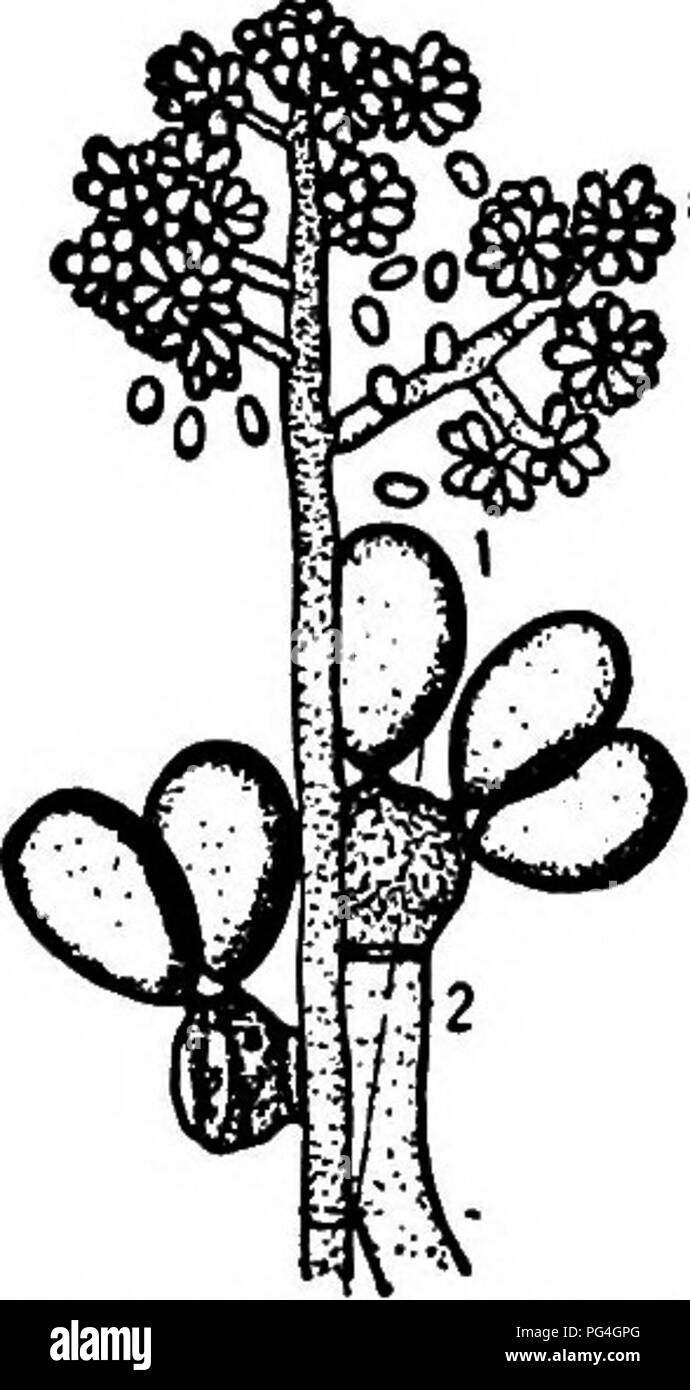
. The fungi which cause plant disease . Plant diseases; Fungi. THE FUNGI WHICH CAUSE PLANT DISEASE 139 FiQ. 93.—S. fuckeli- ana, attachment organ. After Ist- vanffi. On the apple the fungus shows two different modes of develop- ment. In some cases the mycelium accumulates under the epider- mis without producing spores, becomes dark colored and also causes a darkening of the contents of the host cells, which results in a black spot giving rise to the name black rot. In other cases ^^ the mycelium produces a brown rot and abundant conidial tufts, ar- ranged in concentric circles around the point of infection. The form on pomaceous fruits has long been regarded as identical with that on stone fruits; but recently, at least in Eiu-ope, they have been distinguished on cultural and morphological grounds ' (see also ^'"), as separate species, the most distinctive character perhaps being the color of the mass of conidia. In a similar way S. laxa Ad & Buhl, is set aside as a distinct species infecting only apricots. ^^^ American mycologists are inclined to doubt the distinctness of the species on drupes and pomes in this country. S. fructigena (Pers.) Schr. Apothecia from sclerotia produced either in or on mummied fruits, 0.5-3 cm. high, stem dark brown, disk lighter, 5-8 or even 15 mm. in diameter; asci 125-215 x 7-10 /*; spores ellipsoidal, 10-15 x 5-8 (i. Conidia (=Monilia fructigena Pers.). Co- nidiophores covering the fruits of the host with a dense mold-like growth of light brownish-yellow or ochraceous color; spores averaging 20.9 x 12.1 /i. On stone and pome fruits, especially the latter. S. cinerea (Bon.) Wor. Apothecia and asci similar to those of S. fructigena, Conidia (=Monilia cinerea Bon.). Conidiophores covering the fruits with a dense grayish mold-like growth; spores averaging 12.1 x 8.8 It. On stone and pome fruits, especially the former.. Fig. 94.—Typical conid- iophore and conidia of the Botrytis-form of S. fuckeliana. Af- ter Smith.. Please n