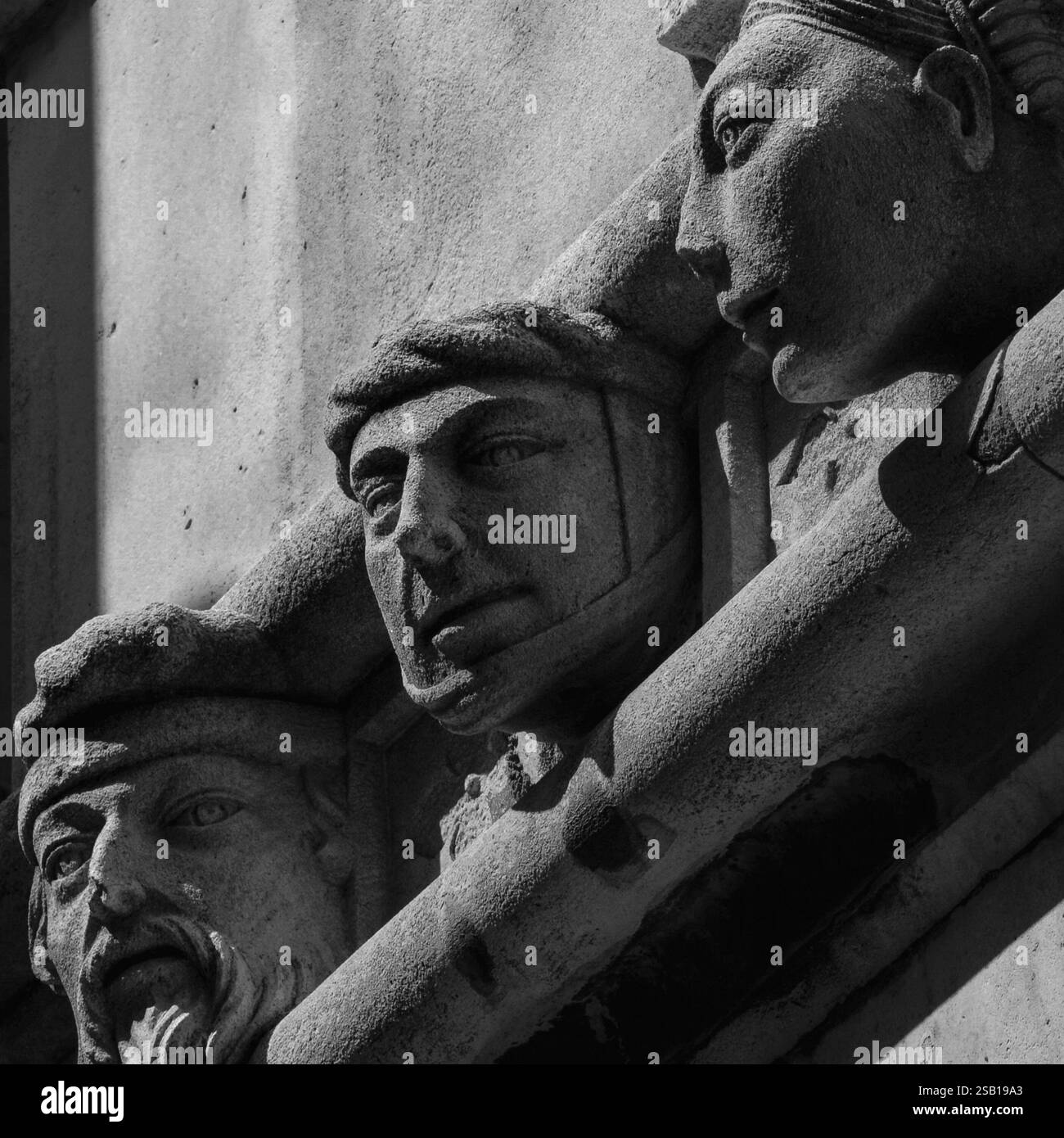
Volti rinascimentali in bianco e nero: Si ritiene che lo scultore e architetto veneziano del XV secolo Giorgio da Sebenico o Georgius Mathei Dalmaticus abbia scolpito 71 somiglianze a grandezza naturale di persone che conosceva in un fregio ritratto esterno intorno alle tre absidi di pietra dell'opera della sua vita, la Cattedrale di San Giacomo sul lungomare Adriatico a Šibenik, Dalmazia, Croazia.
2806 x 2806 px | 23,8 x 23,8 cm | 9,4 x 9,4 inches | 300dpi
Data acquisizione:
4 settembre 2007
Ubicazione:
Cathedral of Saint James, Šibenik, Šibenik-Knin County, Dalmatia, Croatia
Altre informazioni:
Questa immagine potrebbe avere delle imperfezioni perché è storica o di reportage.
Šibenik, Dalmatia, Croatia: these three monochrome likenesses of 15th century men who knew the Venetian sculptor and architect Giorgio da Sebenico (c.1410 - 1473) are among 71 anonymous human portraits and three lion faces he carved in an external frieze on the three apses of his life’s work, the Renaissance Cathedral of Saint James. Giorgio, also known as Georgius Mathei Dalmaticus, Juraj Matejev Dalmatinac and George the Dalmatian, worked on the existing Gothic cathedral from 1441 until his death; from 1443 as its master architect. Despite being a leading exponent of the Gothic form, he was also open to Renaissance principles and he founded a movement in Dalmatia successfully blending elements of the two styles. Giorgio did not live to see the completion of his masterpiece, as it was only finished in 1535 and was not consecrated for a further 20 years. From 1475 to 1505, the celebrated Italian sculptor and architect Niccolò di Giovanni Fiorentino (1418 - 1505), also known as Nicholas of Florence, oversaw a further transformation in the Tuscan Renaissance style, with a graceful dome or cupola surmounting the triple-aisled basilica. The cathedral is built entirely of stone, with unique construction techniques used for the dome and barrel-vaulted roof. Today, it is regarded as the most important Renaissance building in Croatia, gaining the status of a UNESCO World Heritage Site in 2000. Šibenik, historically named Sebenico, was owned from 1412 by the Venetian Republic. Apart from the cathedral and a ducal palace, it is best known for its four fortresses and other strong defences, including walls, ramparts, gateways and a five-sided tower. D0919.B1060.A