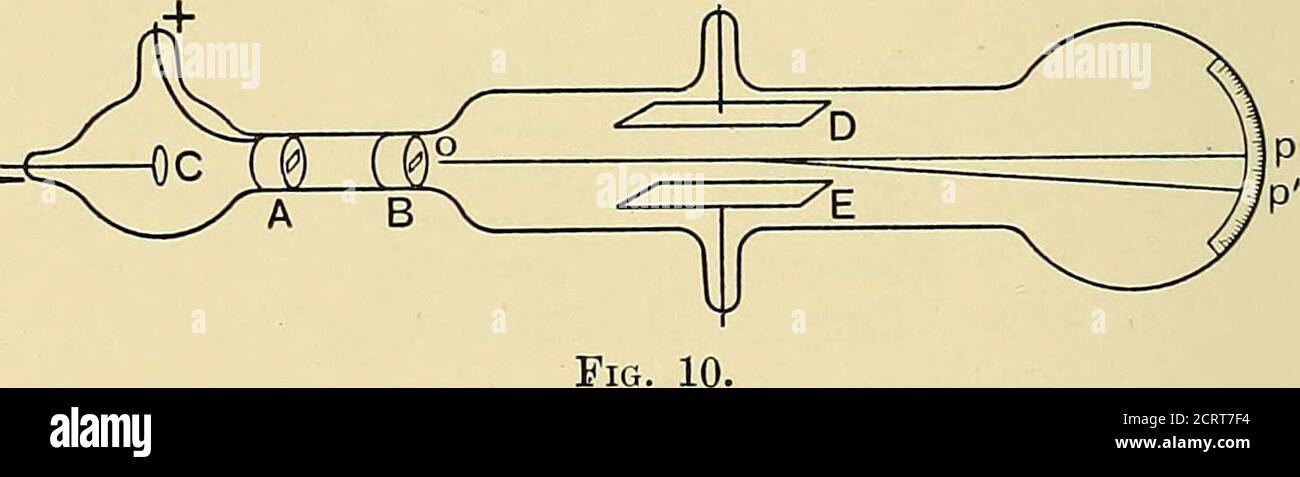
. Radio-attività : un trattato elementare dal punto di vista della teoria della disintegrazione. Radio-attività, poiché per aiuto di essi si è ottenuta conoscenza della massa e della velocità delle particelle proiettate da sostanze radioattive. 50 RADIOATTIVITÀ. Se la particella carica viene proiettata con velocità uniforme ad angoli retti rispetto alle linee di forza magnetica, nessuna forza elettrica, il suo percorso viene modificato in quello di un cerchio il cui raggio di curvatura, p, è dato da mv tie dove m è la massa dello ione, e la sua carica, v la sua velocità, eH la forza magnetica. Questo ci permette di determinare il val
2894 x 863 px | 24,5 x 7,3 cm | 9,6 x 2,9 inches | 300dpi
Altre informazioni:
Questa immagine potrebbe avere delle imperfezioni perché è storica o di reportage.
. Radio-activity : an elementary treatise from the standpoint of the disintegration theory . radio-activity, for by aid ofthem knowledge has been obtained of the mass and velocity ofthe projected particles from radio-active substances. 50 RADIO-ACTIVITY. If the charged particle is projected with uniform velocity atright angles to the lines of magnetic force, no electrical forcesacting, its path is changed to that of a circle whose radius ofcurvature, p, is given by mv tie where m is the mass of the ion, e its charge, v its velocity, andH the magnetic force. This enables us to determine the valueof e/mv. If an electrostatic force is made to act simultaneouslyon the moving ion, so that the lines of electric force are atright angles to the lines of magnetic force, and at right anglesalso to the direction of motion of the ion, the electric forcecan be made either to neutralise or assist the deviationproduced by the magnetic force according as the sign of theP.D. is in the one direction or the other. If it is adjustedso as to oppose the magnetic deviation, a point can be reached, . by the suitable variation of one of the forces, the otherremaining constant, at which the projected particle is notdeviated. At this point it can be shown that the force Fe, where F is the electric force and e the charge on the ion, isbalanced by the force B.ei. Fe = Hev. Therefore, v = F/H, andthe velocity of the ion can be determined. When v is knownthe ratio e/m can also be determined from the ratio e/mv. In this way Prof. Thomson, in 1897, succeeded in determiningthe value of e/m and of v for the negatively charged particlewhich constitutes the cathode ra, j of the Crookes tube. Theapparatus used is shown in Fig. 10. Cathode rays startingfrom C are projected through the diajjhragms AB, whichconsist of fine horizontal slits in metal discs: they thenpass between the two horizontal plates ED, maintainedat a constant P.D., and fall upon the phosphorescent screen THE ELECTRICAL PROPERTIES OF GASES