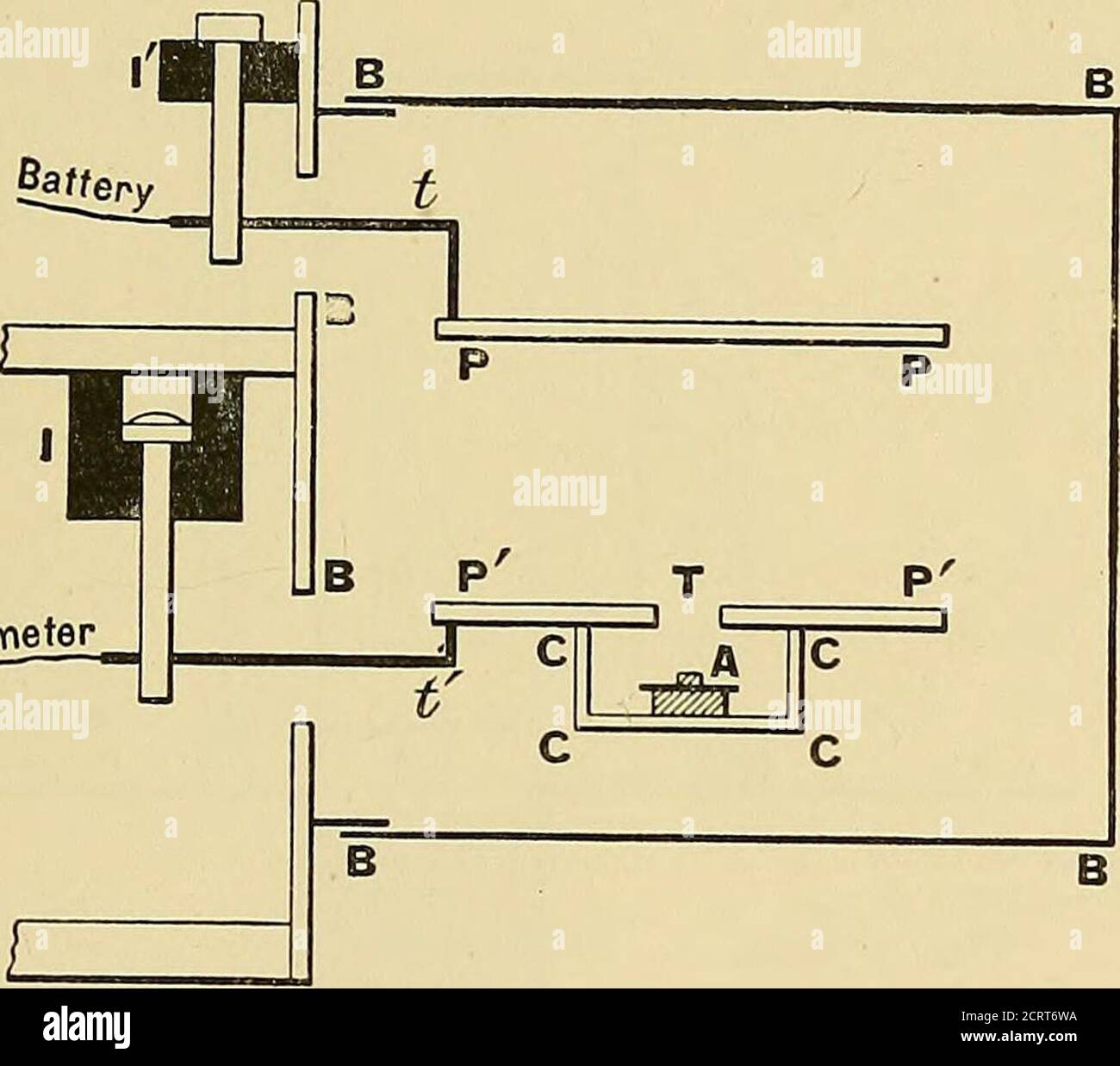
. Radioattività : un trattato elementare dal punto di vista della teoria della disintegrazione . Curie per l'indagine dei raggi a di poloniumis mostrato in Fig. 22. L'oggetto dell'esperimento è la tomasura della corrente di ionizzazione dovuta ai raggi tra le piastre PP, PP da una preparazione di polonio a quando la distanza AT è stata variata. Il foro T nella piastra PP è a, 13 E y-RA YS. 17 ricoperta con il foglio più sottile possibile di lamina di alluminio (non mostrato) per impedire agli ioni formati in CCCC di trovare il loro percorso nello spazio PPPP. Quando A è superiore a 4 cm. Non passa corrente, ad indicare che il raggio
1683 x 1485 px | 28,5 x 25,1 cm | 11,2 x 9,9 inches | 150dpi
Altre informazioni:
Questa immagine potrebbe avere delle imperfezioni perché è storica o di reportage.
. Radio-activity : an elementary treatise from the standpoint of the disintegration theory . Curie for the investigation of the a-rays of poloniumis shown in Fig. 22. The object of the experiment is tomeasure the ionisation current due to the rays between theplates PP, PP from a polonium preparation at A when thedistance AT was varied. The hole T in the plate PP is THE a, 13 AND y-RA YS. 17 covered with the thinnest possible sheet of aluminium foil (notshown) to prevent the ions formed in CCCC finding their wayinto the space PPPP. When AT is over 4cm. no current passes, , indicating that the rays are all absorbed in this thickness of air.The appearance of the rays between the plates is manifested, somewhat suddenly as the distance AT is reduced. If suc-cessive layers of foil are placed over the polonium, the absorp-tion caused by the second layer is greater than that producedby the first. These considerations and the existence of this peculiarity fora-rays generally led Rutherford {Phil. Mag., 1903, VI., 5, p. 177)to regard the a-rays as consisting of projectiles, and to examine. t, ecK2!3l2Il. Fig. 22. them carefully in the most intense magnetic fields under con-ditions where the slightest deviation could be detected. Hisapparatus is represented in Fig. 23. The radium rays passupwards through a series of very narrow slits placed betweenthe poles of a very powerful electromagnet and emerge insidethe gold-leaf electroscope placed above. A current of hydrogenis kept flowing through the electroscope and the slits in adownward direction, and this serves to prevent the diffusionof any emanation from the radium into the electroscope.* It * The aluminium foil placed above the top of the slits serves the samepurpose as in Mme. Curies apparatus just described. It is excessivelythin and, being porous, offers no obstruction to the passage of thehydrogen. 78 RADIO-ACTIVITY. also greatly reduces the absorption of the a-rays in passingthrough the slits, and so increases the effect t