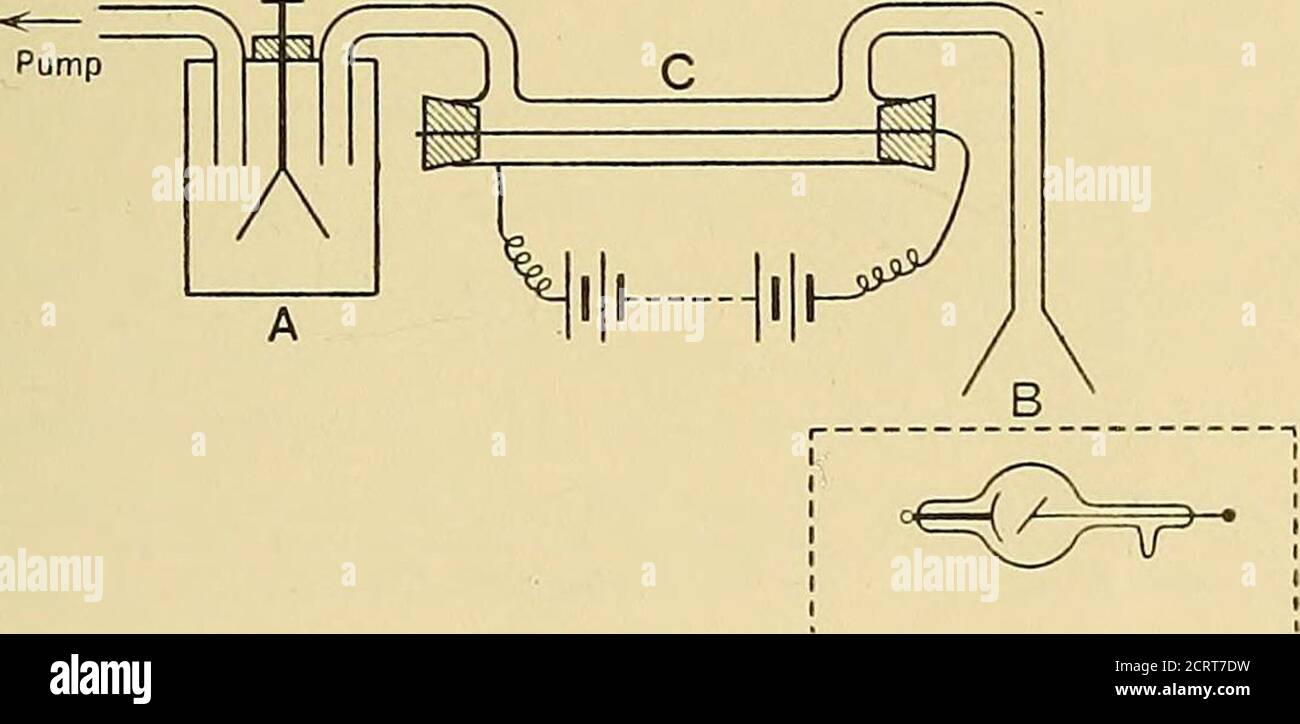
. Radioattività : un trattato elementare dal punto di vista della teoria della disintegrazione . , o esposto nel suo passaggio all'azione di un campo elettrico, cessa di condurre. Così se (Fig. 5) un campo elettrico LE PROPRIETÀ ELETTRICHE DEI GAS. 39 VIENE fatto funzionare sul gas nel suo passaggio collegando ilestemo del tubo metallico C con un polo di una batteria, l'altro polo essendo collegato con un filo centrale isolato e teso lungo il tubo, l'aria che passa nell'elettrosforo lo scarica più a lungo. Qualcosa viene rimosso dall'aria da questi mezzi che sono diversi da m
2263 x 1104 px | 38,3 x 18,7 cm | 15,1 x 7,4 inches | 150dpi
Altre informazioni:
Questa immagine potrebbe avere delle imperfezioni perché è storica o di reportage.
. Radio-activity : an elementary treatise from the standpoint of the disintegration theory . , or exposed in its passage to the action of an electricfield, it ceases to conduct. Thus if (Fig. 5) an electric field THE ELECTRICAL PROPERTIES OF GASES. 39 IS made to operate on the gas in its passage by connecting theoutside of the metal tube C with one pole of a battery, theother pole being connected with a central wire insulated andstretched along the tube, the air passing into the electroscopeno longer discharges it. Something is removed out of the airby these means which is different from the main bulk of the air, and this something consists of the charged ions which carrythe electricity. Since the gas as a whole shows no charge, it follows that an equal number of positive and negativeions exist in the gas, for it has been shown that the chargecarried by the negative ion is equal to that carried by thepositive. It is necessary here to call attention to the distinctionbetween the ions and the radio-active emanations producedby radium and thorium. The latter also possess the power. Fig. of being blown through tubes and discharging an electroscopeat some distance from the radio-active substance. Theemanatfbns, unlike the ions, pass unchanged through filtersand liquids which destroy the ions, and they survive the actionof the electric field. The reason why the electroscope is dis-charged in the latter case is that the emanation is an ionisingagency, and continually produces fresh ions out of the gas afterits passage through the plug. The emanation passes throughthe latter like an ordinary gas, and immediately producesfresh ions out of the gas on the further side. The most characteristic feature of the conductivity of anionised gas, by which it is easily distinguished from all othertypes of electrical conduction, is the existence of a maximumor saturation current, which limits the quantity of electricit.y 40 RADIO-ACTIVITY. the gas is able to convey. In electrolytic and met